
UCWLC Symbols & Emblems
UCWLC Emblem
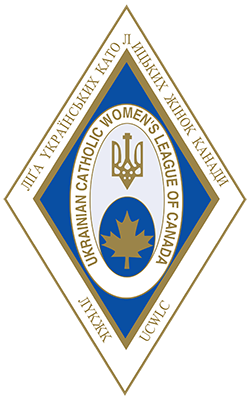
The UCWLC emblem is a rhombus enclosing an oval, within which there is a Trident (Tryzub), the coat-of-arms of Ukraine, bearing a cross, the symbol of Christianity at the top of its center bar, all superimposed on a maple leaf, symbol of Canada, circumscribed with the inscription “UKRAINIAN CATHOLIC WOMEN’S LEAGUE OF CANADA”. The sides of the rhombus bear the inscription “ЛІҐА УКРАЇСЬКИХ КАТОЛИЦЬКИХ ЖІНОК КАНАДИ” and include the Ukrainian and English acronyms, ЛУКЖК and UCWLC.
The colors of the emblem are white, light blue, dark blue, and gold. The four sides of the rhombus symbolize the four fundamental aims of the UCWLC, namely, the Catholic faith, Ukrainian identity, Social and Civic responsibility, and Charity.
The Mother of God of Pochaiv | Official Icon
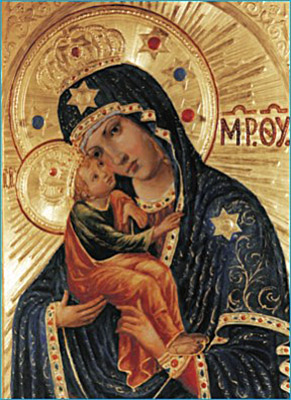
In 1979, the UCWLC National Plenary officially adopted the icon of “Our Lady of Pochaiv” for the Organization
THE MIRACLULOUS ICON OF POCHAIV
Many icons have become miraculous through the intercession of the persons they represent when people experience the healing power of Jesus, or the supernatural intervention in times of danger. Such an icon is The Mother of God of Pochaiv.
The city of Pochaiv (Ukraine) has long been famous for the Pochaivska Bohorodytsia (the Pochaiv Mother of God) and again in the 16th century the fame of Pochaiv was renewed when the first miracle associated with the icon occurred in 1597. This is what happened.
It is recorded that a wealthy woman, Anna Hoyska, brought for herself an icon from Constantinople. This icon remained un her home for 38 years, when it was brought to her attention that the icon gave off an unusual brightness. She immediately thought that the icon must be miraculous. She advised her nephew Philip Kozynsky, who had been born blind to pray before the icon for sight. And sight was given to him. Anna Hoyska then understood that she could not keep the icon in her home and in 1597 she gave the icon to the Basilian monks at the Pochaiv monastery. However, after her death (she had no children of her own) a Lutheran heir Andriy Firley who did not acknowledge her will, attached the monastery, removed the icon along with other treasures. After 20 years, the superior of the monastery, by court procedure won back the custody of the icon. It was then returned to the Church of the Assumption of the Blessed Virgin Mary, the church of the monastery.
The icon became known and people dame from far and near to pray and glorify the Holy Mother of God – beseeching Her graces which she gave out benevolently. By 1661 they started to record the many miracles. The most famous miraculous intervention was the saving of the monastery from an onslaught of the Tartars (Turks). The monastery of Pochaiv was built on a hill and served as a fortress. People took refuge in times of eminent danger of an enemy attack. It appeared now that the end was near to all those who were housed in the monastery. The monks together with all others who were there began their fervent prayers to the Holy Mother of God. As they were singing a hymn in Her honour the heaven opened up and there appeared the Mother of God. She stood above the church and spread out her omophorion, or cape in protection. Seeing the miraculous vision, the attackers retreated from the monastery. This event was immortalized in a popular folk ballad.
Since 1674 it was generally known that tears flowed from the icon of Pochaiv Mother of God. In June 1770, Bishop Sylvester Rudnycky-Lubienychky conducted an official investigation of the miracles that has occurred at Pochaiv and declared them valid. In 10 years, there were 593 recorded miracles. Based on these findings, on May 1, 1773, the Apostolic See issued a decree granting permission to crown the Pochaiv icon. The coronation was magnificent. Over 100,000 people and over 1,000 catholic priests participated in the coronation.
Then came a time of tragedy and sadness. Ukraine who at this time was under the Polish rule, was invaded by the Muscovites. A Process of destroying Ukrainian Catholic churches began. At that time in three provinces, 145 Basilian monasteries were liquidated, and monks fled before the Russians, they took with them the Pochaiv icon. Whether they took the original and left an exact copy or took a copy and left the original is difficult to confirm. However, we can be sure of one thing they took with them affection and devotion to the Pochaiv Mother of God.
A reproduction of “Our Lady of Pochaiv” by artist DeFillippi is housed at SS Peter & Paul Ukrainian Catholic Church administered by the Basilian Fathers (Mundare, Alberta, Canada)
Join your local UCWLC branch!
Are you interested in growing in your Catholic faith, in learning more about our Ukrainian Rite and our heritage, culture and tradition with a chance to help others?
Here is your chance to be part of an organization that benefits your parish and local community, but which is also affiliated with national and world organizations! Reach out to us using the "Contact Us" form and we'll be in touch!